
OpSys
Desalination

AI-Native Intelligence for Desalination Plants

Purpose-built operational intelligence for SWRO, MSF, and hybrid desalination facilities. Optimise specific energy consumption, predict membrane fouling, manage brine compliance, and integrate renewable energy — all from a single AI-native platform.
Greenfield SWRO PlantsMSF ModernisationHybrid MSF-SWRORenewable-Powered DesalIndustrial DesalinationBrackish Water ROMobile Desal UnitsZero Liquid Discharge
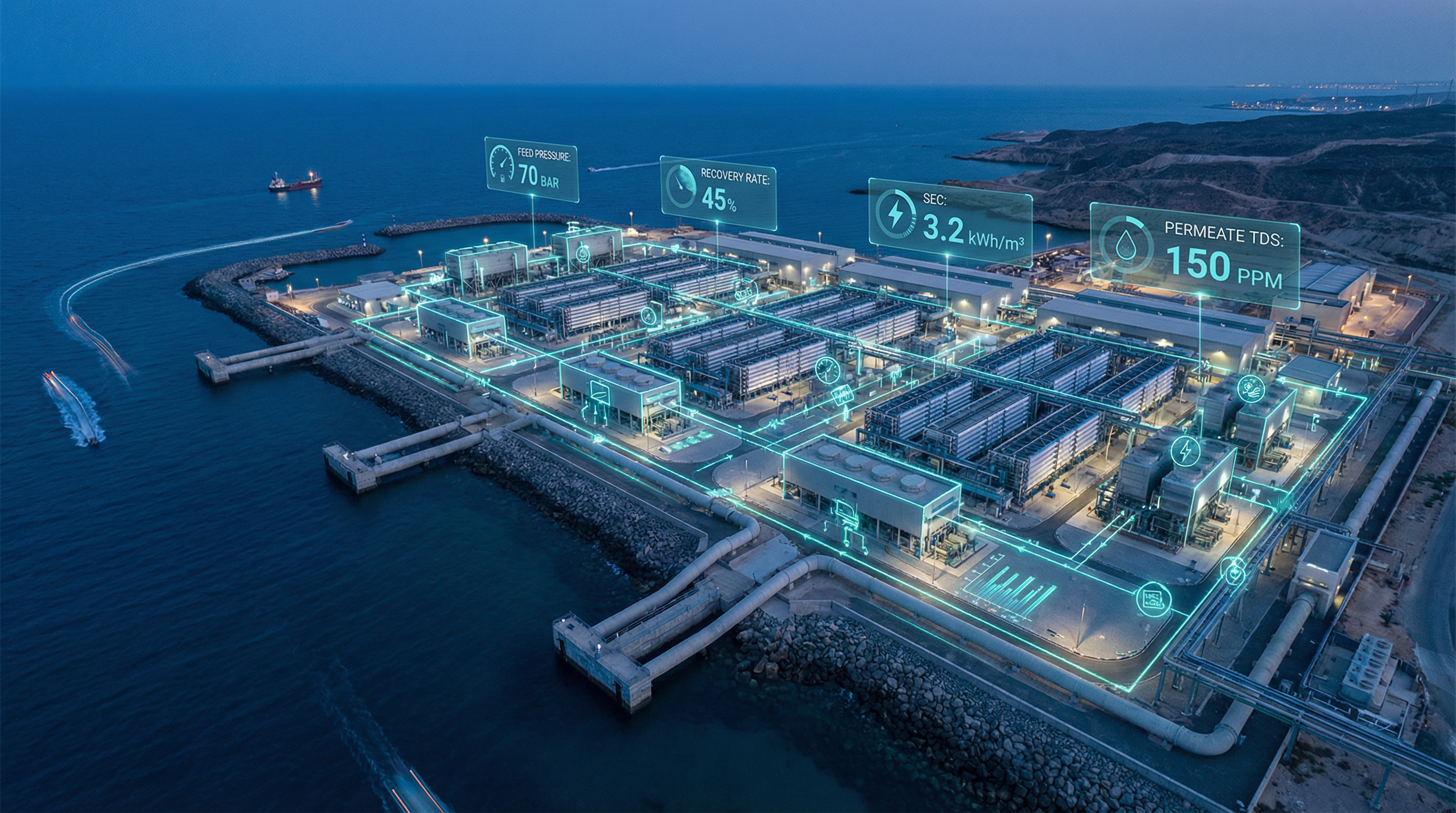
Large-scale SWRO desalination plant with AI digital twin overlay
3.0
kWh/m³ SWRO best-in-class SEC
98%
ERD pressure recovery efficiency
30%
Membrane life extension via AI
< 200
ppm TDS SWRO permeate target
45%
SWRO recovery rate (seawater)
40%
OPEX reduction — hybrid vs. MSF-only
Technology Platforms

SWRO · MSF · Hybrid — OpSys Across All Technologies

OpSys delivers a unified operational intelligence layer across all three desalination technology platforms, enabling consistent KPI monitoring, AI optimisation, and ESG reporting regardless of the process train.

SWROSeawater Reverse Osmosis

The dominant technology for new large-scale desalination projects. High-pressure pumps force seawater through semi-permeable membranes, rejecting salts. Energy Recovery Devices (ERDs) recapture up to 98% of the pressure energy from the brine stream, making SWRO the most energy-efficient option for greenfield plants.

OpSys Value for SWRO
Real-time SEC optimisation via AI-driven feed pressure and flux control
Membrane fouling prediction using differential pressure trend analysis
ERD performance monitoring and predictive maintenance alerts
Automated CIP (Clean-in-Place) scheduling based on normalised flux decline
Key Equipment Monitored
High-Pressure PumpsRO Membrane ArraysEnergy Recovery Devices (ERD)Cartridge FiltersChemical Dosing SystemsPost-Treatment Remineralisation
Technical Specifications
Specific Energy (SEC)3.0 – 4.5 kWh/m³
Water Recovery Rate40 – 50%
Plant Capacity RangeUp to 1,000,000 m³/day
Feed Water TDS35,000 – 45,000 ppm
Product Water Quality< 200 ppm TDS
MSFMulti-Stage Flash Distillation

The legacy thermal technology widely deployed across the GCC, particularly in UAE, Saudi Arabia, and Kuwait. Seawater is heated and flashed through successive low-pressure stages to produce ultra-pure distillate. MSF plants are co-located with power stations to utilise waste steam, achieving very high water purity but at higher energy intensity than SWRO.

OpSys Value for MSF
Steam supply and brine heater temperature optimisation for minimum GOR degradation
Scale formation prediction using saturation index monitoring across all stages
Heat rate and performance ratio trending with AI anomaly detection
Integration with co-generation power plant SCADA for coordinated dispatch
Key Equipment Monitored
Brine HeaterFlash Chambers (18–25 stages)Heat Recovery SectionsBrine Recirculation PumpsDistillate Extraction PumpsDeaerator
Technical Specifications
Specific Energy (SEC)10 – 16 kWh/m³ (thermal + electric)
Water Recovery Rate10 – 25%
Plant Capacity RangeUp to 75,000 m³/day per unit
Feed Water TDSUp to 70,000 ppm
Product Water Quality< 10 ppm TDS
HybridMSF-SWRO Hybrid Systems

The preferred modernisation strategy for GCC utilities operating legacy MSF fleets alongside new SWRO capacity. MSF produces ultra-pure distillate that blends with higher-TDS SWRO permeate to meet final product quality specifications. The hybrid approach maximises asset utilisation, reduces overall SEC, and provides operational flexibility to shift production between technologies based on energy prices and demand.

OpSys Value for Hybrid
Optimal production split between MSF and SWRO units based on real-time energy tariffs
Blending ratio control to maintain product water quality within regulatory limits
Coordinated shutdown and startup sequencing across both technology trains
Unified SCADA dashboard with cross-technology KPI benchmarking and ESG reporting
Key Equipment Monitored
MSF Units (existing fleet)SWRO Trains (new capacity)Product Water Blending StationCommon Intake & OutfallUnified EMS/SCADARenewable Energy Integration
Technical Specifications
Specific Energy (SEC)4.5 – 7.0 kWh/m³ (blended)
Water Recovery Rate35 – 45% (blended)
Plant Capacity RangeFlexible — matches existing MSF assets
Feed Water TDS35,000 – 45,000 ppm
Product Water QualityBlended to < 200 ppm TDS
Process Architecture

End-to-End Desalination Process Coverage

OpSys monitors and optimises every stage of the desalination process — from seawater intake through pre-treatment, core desalination, post-treatment, and brine management.

01
Seawater Intake
Beach wells · Open intake · Screening · Chlorination
02
Pre-Treatment
Coagulation · DAF · UF membranes · Cartridge filtration
03
Desalination Core
SWRO trains · MSF units · ERDs · HP pumps
04
Post-Treatment
Remineralisation · pH adjustment · Disinfection · Fluoridation
05
Storage & Pumping
Product water reservoirs · Booster pumps · Pressure zones
06
Brine Management
Brine dilution · Outfall monitoring · Environmental compliance
Industry Challenges

Desalination Challenges OpSys Solves

Specific Energy Consumption (SEC)
Energy accounts for 30–50% of desalination OPEX. Optimising feed pressure, recovery rate, and ERD efficiency is critical to remaining competitive against alternative water sources.
Membrane Fouling & Scaling
Biofouling, colloidal fouling, and mineral scaling degrade membrane performance and increase cleaning frequency. Predictive monitoring can extend membrane life by 20–30%.
Brine Disposal & Environmental Compliance
Concentrated brine discharge is subject to increasingly strict environmental regulations in the GCC and globally. Real-time salinity and temperature monitoring at the outfall is mandatory.
Renewable Energy Integration
Coupling desalination with solar PV and BESS introduces variable power supply challenges. AI-driven load scheduling must balance membrane operating windows with grid tariffs and renewable availability.
Ageing MSF Asset Management
GCC utilities operate MSF plants built in the 1980s–2000s. Condition monitoring, predictive maintenance, and digital twin modelling are essential to extend asset life and defer replacement capital expenditure.
Water Security & Demand Forecasting
National water security strategies require accurate 24–72 hour demand forecasting to schedule production, manage storage, and coordinate with co-generation power dispatch.
Renewable-Powered Desalination

Solar + BESS + SWRO — The Net Zero Desal Stack

Coupling SWRO with utility-scale solar PV and BESS reduces the carbon intensity of desalinated water by up to 90%. OpSys manages the complex dispatch logic between renewable generation, battery storage, and membrane operating windows.

Solar PV Integration

AI-driven solar forecast informs SWRO production scheduling, maximising renewable utilisation during peak generation hours.

BESS Load Levelling

Battery storage buffers the variable solar output, ensuring stable power supply to high-pressure pumps and preventing membrane stress from power fluctuations.

SEC Optimisation

Real-time optimisation of feed pressure, recovery rate, and ERD efficiency minimises energy consumption per cubic metre of product water.

Carbon Accounting

Scope 1, 2, and 3 emissions tracking per m³ of water produced, with automated reporting for regulatory compliance and ESG disclosure.

Standards, Protocols & Regulatory Frameworks

IEC 61511 (Functional Safety — SIL)IEC 62443 (OT Cybersecurity)IEC 61850 (SCADA Communications)Modbus TCP/RTUDNP3OPC-UAISO 55001 (Asset Management)ISO 14001 (Environmental Management)WHO Drinking Water GuidelinesGCC Drinking Water StandardsASTM D4189 (Silt Density Index)NACE MR0175 (Corrosion Control)

Optimise Your Desalination Operations

From SWRO SEC optimisation to MSF digital twin and hybrid production scheduling — OpSys delivers AI-native intelligence across the full desalination technology spectrum.